
Services
EKG and ECHO in Aventura
Call your pediatric office to ask about in-house heart screenings and schedule an appointment

In-house EKG and ECHO services are available at select locations
Testing by pediatric experts
Evaluation of results
Easy scheduling
Familiar faces

EKGs get to the heart of the matter
Electrocardiograms (EKGs) are an important clinical tool used to detect abnormal heart rhythms, heart murmurs, congenital heart defects, and other pediatric heart concerns that may present as
Chest pain
Rapid or irregular
Shortness of breath
Dizziness
Fainting
Your child may require an EKG as part of pre-participation sports clearance or as a follow-up for abnormal findings on a routine exam. We also use EKGs to help monitor existing congenital heart conditions.
All EKG evaluations and results are coordinated by your Pediatric Associates care team, so pediatric specialists are always involved in your child’s heart care.

ECHO testing may also be available
An echocardiogram, also known as an ECHO, uses ultrasound technology to create a moving picture of your child’s heart. This test (which is also non-invasive and painless) provides real-time views of the heart’s chambers, valves, and blood vessels – allowing us to evaluate how well your child’s heart is pumping, check blood flow patterns, and more.
For ECHO testing, we apply a special gel to your child’s chest and use a transducer wand to capture the images. We also attach electrodes to their chest to monitor their heart rhythm.
Your child will be able to watch videos, listen to music, or even nap during the test, which usually takes 30-60 minutes. Like an EKG, our pediatric heart specialists then review the results to search for abnormalities.
When more cardiac care is needed
What to expect during an electrocardiogram
How do we determine if your child has a normal electrocardiogram or an abnormal electrocardiogram? And what are the symptoms of an abnormal electrocardiogram? Pediatric Associates has these answers for you and more.
A normal EKG shows a healthy and regular heartbeat with a consistent pattern of intervals (waves) between the beats. A child’s normal heart rate can range from 60 to 190 beats per minute, depending on their age.
An abnormal EKG reveals any irregularities in heart activity, such as beating too fast or too slow. Your child’s heart could also skip beats or have extra beats. Some of these variations are minor, while others can indicate serious issues like arrhythmia, cardiomyopathy, or congenital heart defects (structural problems with the heart or blood vessels that are present at birth).
EKG testing is non-invasive and painless
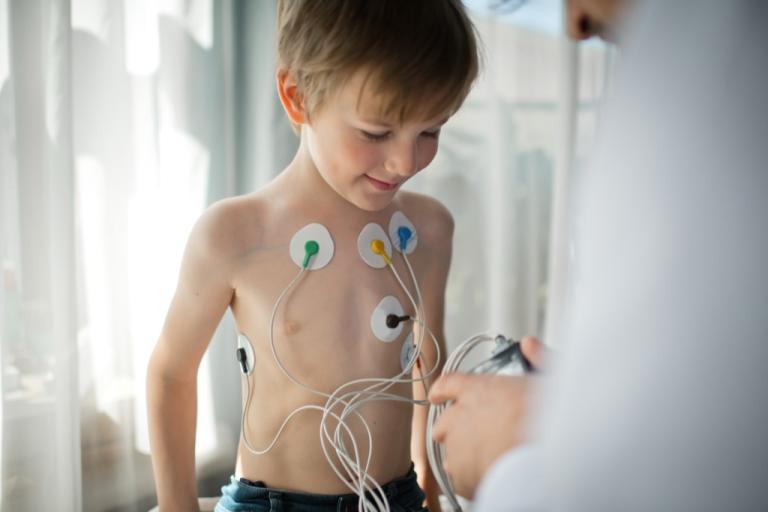
Your pediatric provider attaches small, sticker-like electrodes to your child’s chest, arms, and legs, which are then connected by wires to the EKG machine to record their heart’s electrical signals. Your child can watch videos or listen to music to stay calm and still while the test is conducted.
Once the test is complete, the electrodes are removed. Our pediatric heart specialists then review the results to check for any abnormalities.